Kumi Sugai (1919-1996)
Kumi Sugai was one of the defining Japanese voices of postwar Paris. Kobe was both his birthplace and, in 1996, the city where his life ended. After leaving the Osaka School of Fine Arts without a diploma, he earned his living in advertising for the Hankyu railway, and in 1952 he settled alone in Montparnasse.
Recognition came fast. A first solo exhibition at Galerie Craven in 1954 opened the way to shows across Europe, New York and Tokyo, Stockholm among them, and in 1959 he took part in documenta in Kassel. Museum retrospectives followed in Leverkusen in 1960 and at Kunstnernes Hus in Oslo in 1967.
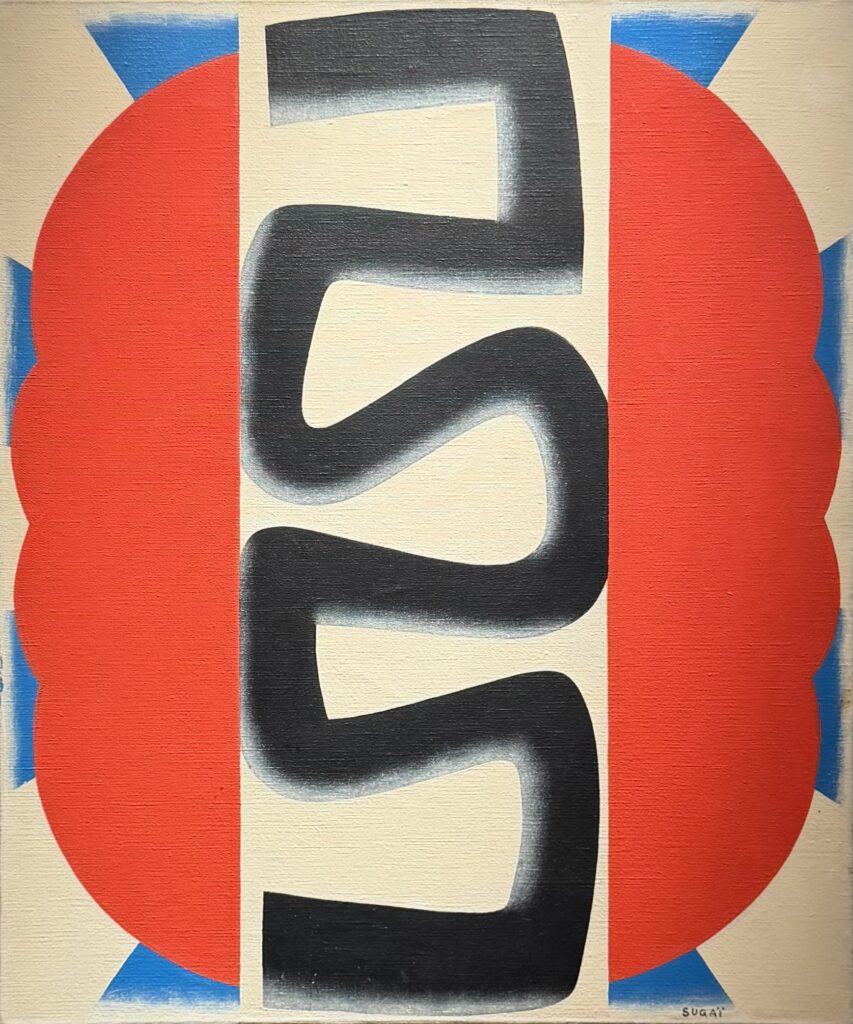
Calligraphy and Western typography both fed his work, which matured into hard-edged geometric abstraction. Pure primary colours carry what became known as his “autoroute” aesthetic: signs built for speed, read in an instant. Printmaking, which he took up in 1955, runs alongside the painting throughout.
Today the Metropolitan Museum of Art, the Guggenheim and MoMA in New York all hold his work, as does the Centre Pompidou.