Robert Motherwell (1915–1991)
Robert Motherwell was the youngest of the Abstract Expressionists and the movement’s most eloquent voice.
Born in Aberdeen, Washington, he studied philosophy at Stanford and Harvard before moving to New York in 1940, where the art historian Meyer Schapiro urged him toward painting.
A journey to Mexico with the Surrealist painter Matta in 1941 settled the matter, and in 1944 Peggy Guggenheim gave him his first solo exhibition at Art of This Century.
From the Surrealists Motherwell took automatism, the idea that a painting could begin in the unguarded gesture, and joined it to a deep feeling for European modernism.
In 1948 he began the Elegies to the Spanish Republic, stark processions of black ovals and vertical bars against white, a meditation on life and death that he returned to for the rest of his life. The spare, luminous Open series followed in 1967.
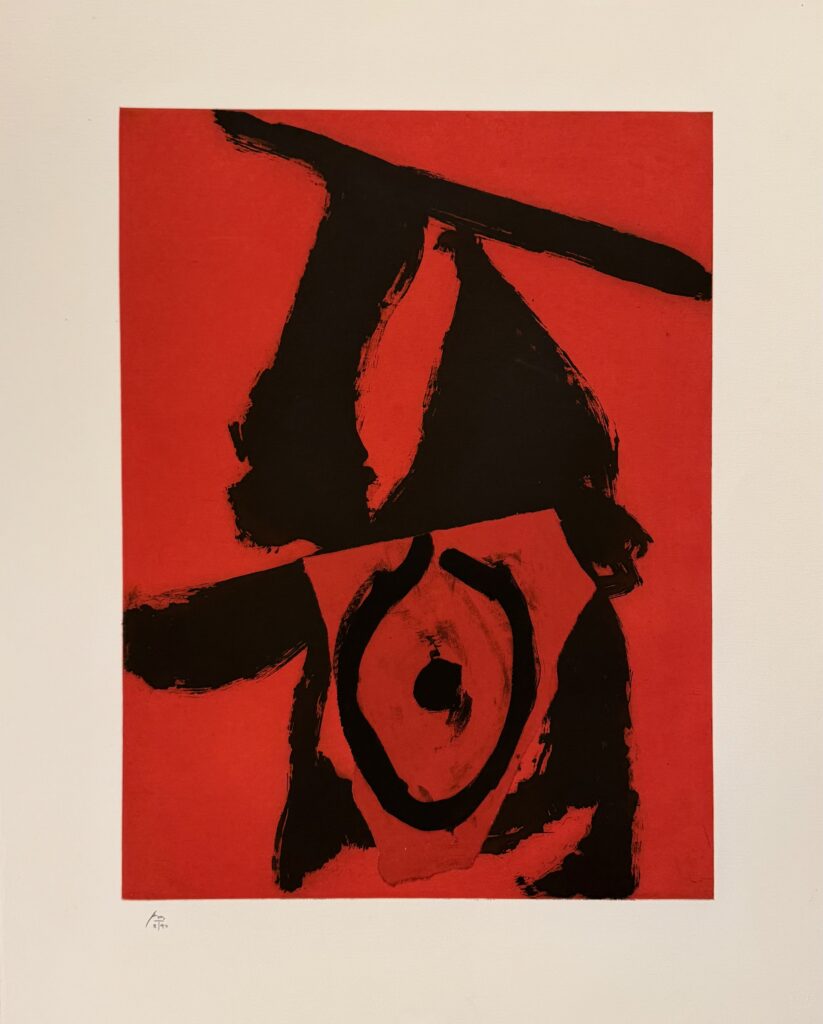
He was equally inventive in collage and, from the 1970s, in printmaking, which became central to his practice.
The Museum of Modern Art honoured him with a retrospective in 1965, and he received the National Medal of Arts in 1989. Motherwell died in Provincetown, Massachusetts, in 1991, leaving a body of work in which intellect and raw feeling are held in rare balance.